How Much Does Startup Branding Actually Cost? A Founder's Honest Breakdown
TL;DR. Startup branding costs anywhere from $0 to $150,000+, but that range is misleading. Design is now cheap - often free with AI - and the real cost has shifted to building and maintaining your brand's presence in search and AI systems. There are four spend tiers (DIY, freelancer, boutique studio, full agency), but most founders don't have a spend problem - they have a sequencing problem. Do strategy before design, stay scrappy on visuals, and budget for presence as an ongoing, pay-as-you-go cost: roughly $200/month bootstrapped, ~$800 at seed, ~$2,000 at Series A. Your brand is what AI says about you when you're not in the room - that's what's worth paying for.
Every founder who asks "how much does startup branding cost?" is really asking something else: how much of my limited runway do I give up to not look like an amateur? I've sat in that exact conversation - do we spend this on branding, or on staying alive another month? So here's the honest answer, not the agency answer. The real range is $0 to $150,000+, but the number that's right for you depends on your stage, what you're actually buying, and - most importantly - whether you spend it in the right order. After building two startups from zero and analyzing how 2,500+ brands present themselves, I've concluded most founders don't have a branding spend problem. They have a sequencing problem.
Why I can actually answer this
My credibility here comes from the founder's chair, not the agency's. I've built two startups from zero - RestCase, an API design and testing platform, and now DataEase AI, a brand presence intelligence platform that has analyzed over 2,500 brands. So I don't just have a brand; I've built a product about branding, and spent years studying what signals trust and what quietly wastes money. I've also paid across the full range - the scrappy DIY logo phase, freelancers in the $500 to $2,000 band, our own AI logo generator, and full brand-system evaluations.
What I haven't done is run an agency or bill clients for branding, and I won't pretend otherwise. My lens is the founder's P&L, not the studio's invoice - which is the more useful perspective here. I know what it feels like to write the check, question the ROI, and live with the result.
The real price tiers of startup branding
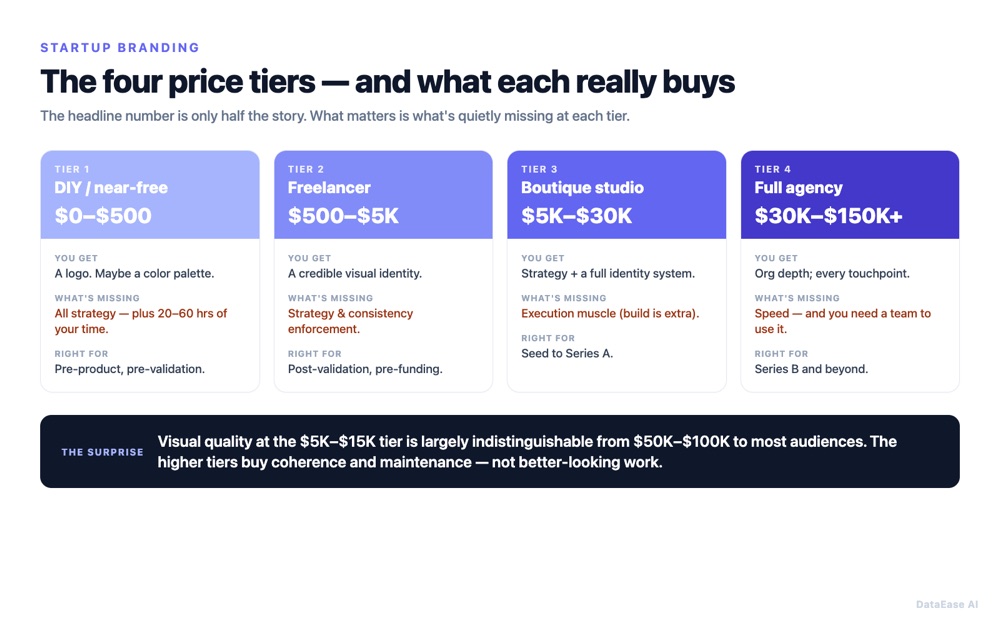
There are roughly four tiers of startup branding, and the price gaps between them are enormous. What matters isn't just the number - it's what you actually get, what's quietly missing, and who each tier is genuinely right for.
Tier 1: DIY / near-free ($0 to $500)
At this tier you get a logo and maybe a palette. Canva hands you templates that look like everyone else's; AI logo generators - including ours at DataEase - are faster and more distinctive. But it's still just a mark, not a brand system, and the real hidden cost is time: DIY branding quietly eats 20 to 60 hours you never track. It's right for the pre-product stage - if you haven't talked to fifty customers, don't spend real money on branding. We did exactly this with DataEase's early iterations: a placeholder identity until we knew what we were building.
Tier 2: Freelancer ($500 to $5K)
At $500 to $1,500 you get a logo and maybe a one-page style guide; at $2,000 to $5,000 a strong freelancer delivers a genuinely good visual identity. What's missing is strategy - most freelancers here are designers, not strategists - and consistency: you get a PDF nobody reads, and six months later your deck, site, and LinkedIn banner look like three different companies. Still, it's right for the post-validation, pre-funding stage, when you need to stop looking embarrassing in front of investors. And from the 2,500+ brands we've analyzed, the visual gap between a good freelancer and a boutique studio is smaller than founders assume - the strategic gap is where it opens up.
Tier 3: Boutique studio ($5K to $30K)
Here branding becomes a process, not a deliverable: a good boutique runs discovery, positioning, and messaging before anyone designs. At $10K to $20K, expect a strategy document, a verbal identity, a full visual system, usable guidelines, and a launch kit. What's missing is execution muscle - implementation is usually quoted separately and adds up fast. The subtler risk is translation loss: the process can produce something coherent but emotionally wrong, that no longer feels like you. It's right for seed to Series A, and often delivers 80% of a full agency's value at 20 to 30% of the cost.
Tier 4: Full agency brand system ($30K to $150K+)
Here you're buying organizational depth - a full team of specialists, exhaustive deliverables across every touchpoint, and, at $100K+, access and reputation that signal seriousness to your board. What you give up is speed and founder intimacy: engagements run four to six months, and the seniors who sold you get swapped for junior execution teams. The biggest catch is that the spend assumes internal capacity to activate it - without a marketing team to maintain the system, you've bought a Ferrari and have no road. (I've watched well-funded startups look like three different companies across their own channels six months post-launch.) It's right for Series B and beyond, brands where the brand is part of the product - consumer, fintech, health - and post-pivot rebrands that need a clean break.
The number that surprised me most
From analyzing 2,500+ brands at DataEase, here's the finding that reframed how I think about spend: visual quality at the $5K to $15K tier is largely indistinguishable from the $50K to $100K tier to most audiences. What the higher tiers actually buy is strategic coherence, organizational alignment, and maintenance infrastructure - and if you're a ten-person startup, you don't need the last two yet. Spend on strategy. Be scrappy on execution.
Two branding spend stories from my own companies
Numbers stay abstract until they're attached to a real decision. Here are two from my own companies - one where spending nothing cost me, and one where the cheapest part of the work was the most valuable.
The $0 brand that cost us credibility (RestCase)
When I built RestCase I did what most technical founders do: spent zero on branding and told myself the product would speak for itself. A logo in a few hours, colors I liked, shipped. We had a working product, early users, and a brand that looked like it was built in a few hours - because it was.
The product was solid. The brand undermined it in every enterprise conversation we had. When you're selling to developers, the product can carry you early - developers are forgiving of aesthetics if the tool works. But the moment we started talking to procurement, to CTOs at larger organizations, to anyone evaluating us against funded competitors with proper brand systems, the visual gap became a trust gap. We looked like a side project, because visually, we were.
The regret isn't that we spent zero in month one - that was right. It's that we kept spending zero once we were already in real sales conversations, optimizing against something that felt superficial while it quietly cost us deals we couldn't measure. There's a specific moment when "we'll fix the brand later" stops being scrappy and starts being expensive: the first time a serious prospect sees your website before they've talked to you. A $3K to $5K freelancer engagement at that point would have paid for itself in the first enterprise deal it helped close.
The brand investment that changed how we saw ourselves (DataEase)
With DataEase I was determined not to repeat that mistake - but also not to over-invest before product-market clarity, the other failure mode founders ignore. So we ran lean: an AI-generated logo, basic colors, good-enough typography. Functional, not memorable.
The turning point came when we were preparing a more serious go-to-market push - reaching out to investors, doing outbound to founders, publishing content under the DataEase name. I looked at our brand and realized it wasn't wrong, it was neutral. It communicated nothing. And for a product whose entire value proposition is about how your brand shows up in the world - how AI models perceive and cite you, how visible you are in the new search landscape - a neutral brand was almost a credibility contradiction. Our product was about brand presence. Our own brand had no presence.
We didn't go to a boutique studio. We ran several iterations ourselves - under $200 of external spend - but treated it like a proper brand exercise: we wrote down our positioning, defined our tone of voice, and got opinionated about what DataEase should feel like before touching any visual. The visual change was subtle, but the internal effect was not. When your brand has a point of view, your writing gets sharper, your outbound carries one voice, and your product copy stops sounding like three different people wrote it. The brand became a filter - does this feel like DataEase? - that made every downstream decision faster.
The surprise was that the most valuable output of the whole exercise wasn't any visual asset. It was a one-page document describing who DataEase was for, what it believed, and how it talked. That document has been referenced more than any logo file we own.
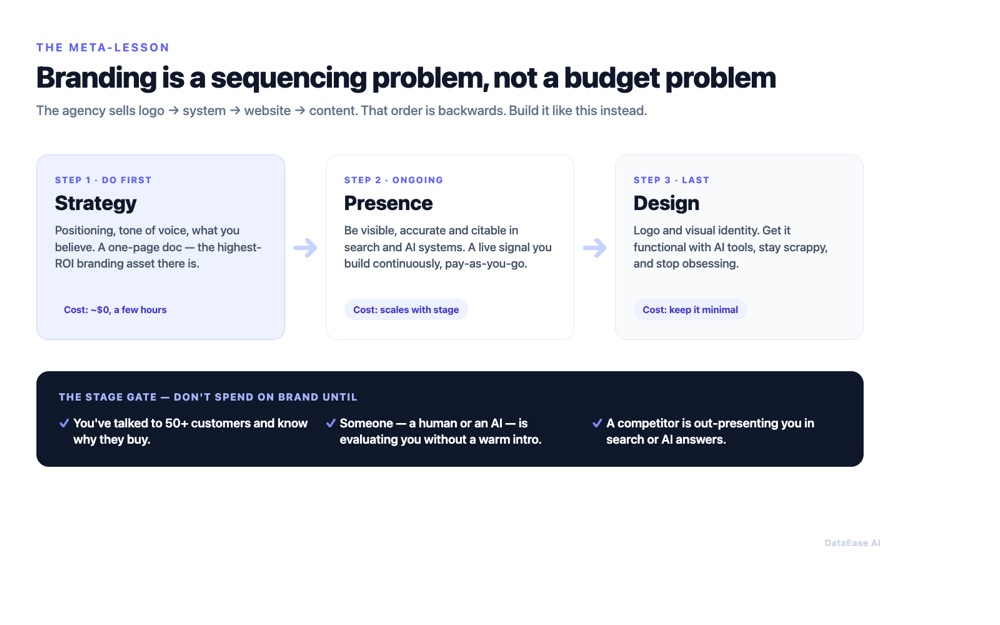
The lesson: brand strategy is cheap, brand design is what costs money - and that's exactly the trap. Strategy is the part that actually matters, but because it's "cheap" (mostly your own thinking, not an invoice) most founders undervalue it, skip it, and go straight to the design. That's why they end up with something that looks fine and means nothing. Flip the order: the $0 brand document that defines your positioning, voice, and belief system is the highest-ROI branding investment you can make - and you can do it before you spend a dollar on a designer.
The meta-lesson: it's a sequencing problem, not a budget problem
Across both companies, the pattern is the same. Timing and sequence matter more than budget. Underspend early, invest when you're in real conversations, and do the strategic work before the visual work, in that order. Almost every branding mistake I've seen - including my own - is a sequencing mistake dressed up as a budget mistake.
How much should you spend? A framework for your situation
Most branding advice is still solving the wrong problem. Founders come looking for logo pricing and leave with a PDF brand guide nobody opens. The real question in 2026 isn't "how much should I spend on design?" - it's "how visible is my brand where it actually matters, and am I building that visibility systematically?" Design is the least of your worries.
The visibility stack has changed
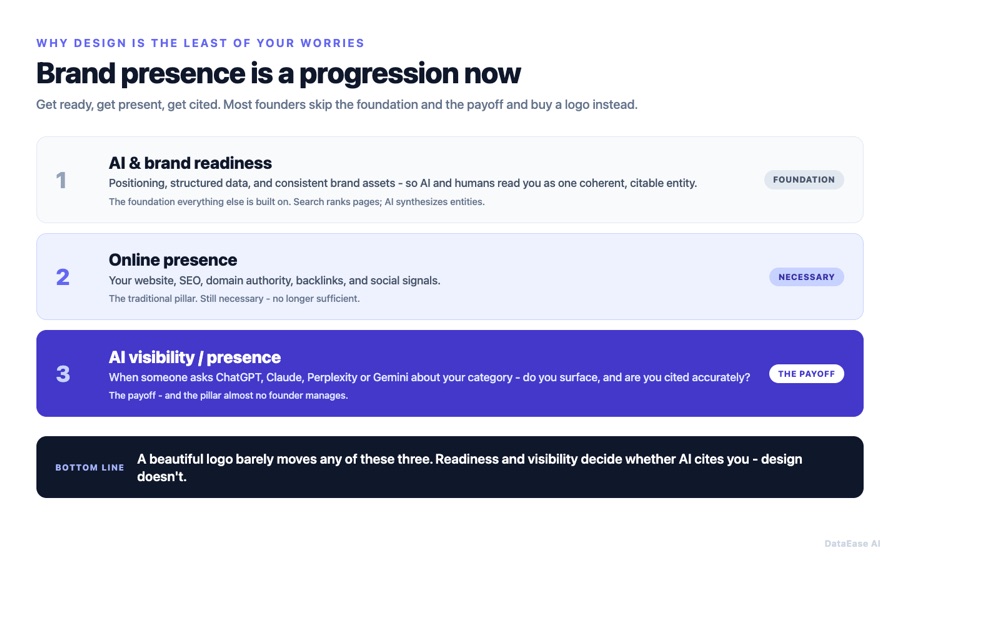
For most of startup history, brand presence meant a logo, a website, and maybe some print collateral - you hired a designer, launched, and were done. That model is obsolete. Brand presence now operates across three pillars at once, and most founders pour everything into one while ignoring the others:
- AI & brand readiness - the foundation: your positioning, structured data, and brand assets shaped so AI (and humans) read you as one coherent, citable entity. Search engines rank pages; AI synthesizes entities - so if your About page, LinkedIn, press, and product descriptions don't tell one consistent story, models either ignore you or get you wrong.
- Online presence - your website, SEO, domain authority, backlinks, and social signals. The traditional pillar. Still necessary, no longer sufficient.
- AI visibility / presence - the payoff: when someone asks ChatGPT, Claude, Perplexity, or Gemini about your category, does your brand surface, and is it cited accurately? This is the pillar almost no founder manages. We built DataEase because we watched brands with strong visual identities go invisible in AI answers, while brands with minimal design but strong content authority got cited constantly.
A logo barely moves any of these three. That's the gap most branding conversations in 2026 are simply not having.
The stage-gate test (start here)
Before you touch a budget, answer three questions honestly.
- Have you talked to 50+ customers and understood why they buy? If not, don't spend on brand yet - spend on conversations. Your positioning can't be right if you don't know what customers value; every dollar before this works with bad inputs.
- Is a real human - or an AI system - evaluating you without a warm intro? A prospect Googles you, an investor asks an AI about your category, a recruit searches your name. If that's happening and you care about the outcome, it's time to manage your presence across all three pillars, not just the visual one.
- Are you losing ground to a competitor who appears more authoritative? Not better product - more present, in search, AI answers, and third-party coverage. If so, you have a visibility gap that's becoming a revenue gap.
The new budget model: pay as you go
The old model was project-based: hire an agency, pay a large upfront fee, get a deliverable, hope it ages well. That made sense when a brand was a static artifact - a logo, a style guide, a website. Brand presence in the AI era isn't static; it's a live signal that improves or decays based on what you publish, what gets cited, and what others say about you. Managing it is an ongoing activity, not a one-time project.
That changes the economics entirely. The right model now is pay-as-you-go - credits, not retainers. Instead of a $5K-per-month agency retainer, you use AI-native tools for content, citation monitoring, and GEO (Generative Engine Optimization) testing, and pay per output. The marginal cost of a piece of brand-building content drops by an order of magnitude, so the question becomes whether you're producing it systematically - not whether you can afford to. At DataEase AI we've built this into the product: founders pay for analysis runs, not seats or retainers, and scale that spend with their stage rather than a fixed billing cycle.
What to stop paying for
- Large upfront design projects before you have positioning clarity. Strategy comes before design - and strategy now includes your AI presence architecture, not just your messaging pillars.
- Agency retainers for brand management. Unless the retainer delivers measurable presence outcomes - citations, AI visibility, content authority - you're paying for activity, not results.
- One-time brand audits. Presence in the AI era is a moving target; a snapshot from six months ago is already partly stale. Pay for continuous monitoring, not periodic reports.
- The 60-page brand guidelines document. Still the thing agencies love to produce and founders never use.
The true all-in cost of branding in year one
Most budget conversations are dishonest by omission - they quote the logo and ignore everything else. Add it all up honestly (design, website, content, AI-presence work, and your own time) and the real number looks like this. And don't forget founder time has a cost: at a $5M valuation working 60-hour weeks, every hour spent tweaking templates is real money that never shows up on an invoice.
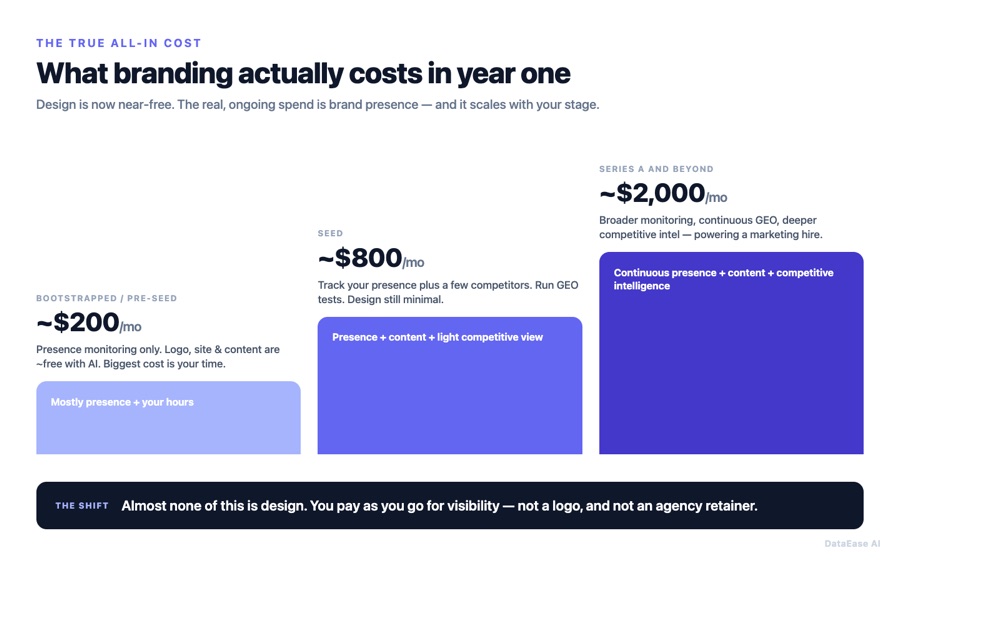
Bootstrapped / pre-seed: under $200 per month
In 2026 the biggest line items from the old playbook are effectively free. Logo and visual identity? AI branding tools handle it at near-zero cost. Website? Template builders plus AI copy get you to credible. Content? Generate structured, GEO-optimized work on credits instead of hiring a writer, and build your entity footprint across the web. What you actually pay for is presence monitoring - around $200 a month - plus ten to twenty hours of your own time to set it all up. That's the honest budget.
Seed stage: around $800 per month
At seed, design and website stay cheap; what changes is competitive scope. Around $800 a month buys continuous tracking of your own presence plus several competitors, with enough capacity to run GEO tests and AI-answer benchmarking on a regular cadence - scaled up when you're optimizing, down when you're heads-down on product.
Series A and beyond: around $2,000 per month
At Series A your brand is a recruiting, sales, and investor signal at once. Around $2,000 a month covers broader competitive monitoring, continuous GEO optimization, and the intelligence to decide where to invest content effort - powering a marketing hire rather than replacing one. What you're still not buying: big agency retainers, stale one-time audits, or motion assets nobody asked for.
The one thing almost everyone gets wrong
Here it is, as plainly as I can say it: founders don't have a branding spend problem. They have a sequencing problem - and agencies have built business models on exploiting it. The standard pitch is logo, then system, then website, then content, then maybe SEO; each phase unlocks the next and carries a fee, with the implicit promise that finishing the sequence means your brand is "done." That sequence is backwards, and the destination doesn't exist. Your brand is never done - it's a live signal that AI systems continuously re-synthesize, in a category being redefined around you in real time. Treat it as a project you complete and you end up with a beautiful identity nobody - human or AI - has ever actually encountered.
The thing I'd want every founder to remember is this: a logo is a name tag, but presence is a reputation. You can buy a name tag for $500, or get one free with AI today. Reputation is built in public, over time, and it compounds - or it doesn't. In 2026, your brand is what AI says about you when you're not in the room. Design gets you dressed. Presence gets you known. Most agencies sell you the outfit. Almost nobody is helping you build what gets said about you when you leave. That's the gap. That's what's worth spending on.
Frequently asked questions
How much should a pre-seed startup spend on branding?
As close to zero on design as you can manage. Before product-market signal, use AI logo and website tools, keep the visual identity functional, and spend your limited budget - realistically under $200 a month - on understanding how you show up in search and AI answers. The biggest cost here is your own time, so cap it at ten to twenty hours of setup rather than weeks of tweaking.
What's the difference between brand strategy cost and brand design cost?
Brand strategy is cheap and high-leverage - it's the positioning, tone of voice, and belief system you can write down yourself for the cost of a few focused hours. Brand design is what carries the real invoice, because it's labor: logos, systems, guidelines, asset kits. Most founders pay for design first and skip strategy, which is exactly why they end up with something that looks fine and means nothing. Do the strategy before you spend a dollar on a designer.
Is it worth paying $50K+ for a full agency brand system?
Only if you have the internal team to activate it. A six-figure system assumes marketers to enforce the guidelines and build on the asset library; without that you've bought a Ferrari with no road. It's genuinely worth it at Series B and beyond, for brands where the brand is part of the product (consumer, fintech, health), or for a post-pivot rebrand that needs to force organizational alignment.
How much does a startup logo cost in 2026?
Anywhere from free to a few thousand dollars. AI logo generators produce a usable mark at near-zero cost, a freelancer charges $500 to $2,000 for a logo plus a basic style guide, and a strong freelancer at $2K to $4K delivers a full visual identity. But here's the thing worth internalizing: from analyzing thousands of brands, the visual quality at the low-to-mid tier is largely indistinguishable from the premium tier to most audiences. The logo is rarely where your money is best spent.
Bottom line
Startup branding can cost anywhere from nothing to six figures, but the headline number was never the real question. Design is now table stakes - get it functional with AI tools and stop obsessing. The real investment in 2026 is visibility: are you present, accurate, and authoritative in search, in AI systems, and in the places your buyers actually look? Underspend on design early, do strategy before visuals, build presence continuously and pay for it as you go - and measure it like a growth metric, because that's what it is. Your brand is what AI says about you when you're not in the room, and that's the spend that compounds.
How to cite this guide
DataEase AI. How Much Does Startup Branding Actually Cost? A Founder's Honest Breakdown (2026). DataEase AI Blog, June 17, 2026. https://blog.dataease.ai/how-much-does-startup-branding-cost/. Perspective: written from the founder's chair, drawing on building RestCase and DataEase AI and analysis of 2,500+ brands.